Media Summary: Demonstrating how complex systems can arise from simple rules, Programs aren't capable of generating true Surfing the web and Internet stacks. Free audiobook:

Random Boolean Networks Computerphile - Detailed Analysis & Overview

Demonstrating how complex systems can arise from simple rules, Programs aren't capable of generating true Surfing the web and Internet stacks. Free audiobook: You don't just 'run a cipher' - you need a mode of operation. Dr Mike Pound explains some relative to the Feistel cipher. **This ... Going hand in hand with Oblivious Transfer is 'Garbled Circuits' - a way of using logic gates to carefully share information. Dr Tim ... Matching pictures on playing cards could have something in common with trying to guess which router has the correct routing ...

Share part of a secret without knowing which part? Dr Tim Muller explains how Oblivious Transfer works. ISPs don't always get it right - they gamble that all of their subscribers won't use all of their bandwidth all of the time. Dr Richard ... The back door that may not be a back door... The suspicion about Dual_EC_DRBG - The Dual Elliptic Curve Deterministic ... A simple bit-shift operation can generate amazing How do huge websites keep track of the traffic numbers? Buck Shlegeris outlines the probabilistic counting algorithm 'Hyperloglog ... A hacked car that could kill you should be more worrying than a thousand lightbulbs taking Facebook offline. University of ...

What goes on TOR stays on TOR, or so we hope. Dr Mike Pound takes us through how Onion Routing works. This video was ... Programming loops are great, but there's a point where they aren't enough. Professor Brailsford explains. EXTRA BITS: ... Finite State Automata meets Recursion. Professor Brailsford continues the story of computers without memory. State Machines ... Terms & Conditions as complicated to read as the epic poem Beowulf. How many times have you clicked 'agree' without reading ...

Photo Gallery

Random Boolean Networks - Computerphile
True Random Numbers - Computerphile
Almost All Web Encryption Works Like This (SP Networks) - Computerphile
Network Stacks and the Internet - Computerphile
Modes of Operation - Computerphile
Garbled Circuits - Computerphile
Who's Telling the Truth? Using "Gobble" - Computerphile
Oblivious Transfer - Computerphile
Why Internet Slows Down When it's Busy - Computerphile
Elliptic Curve Back Door - Computerphile
Random Numbers with LFSR (Linear Feedback Shift Register) - Computerphile
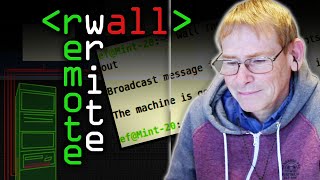
RWALL (Remote Write to All) - Computerphile
View Detailed Profile
Random Boolean Networks - Computerphile

Random Boolean Networks - Computerphile

Demonstrating how complex systems can arise from simple rules,

True Random Numbers - Computerphile

True Random Numbers - Computerphile

Programs aren't capable of generating true

Almost All Web Encryption Works Like This (SP Networks) - Computerphile

Almost All Web Encryption Works Like This (SP Networks) - Computerphile

Substitution-permutation

Network Stacks and the Internet - Computerphile

Network Stacks and the Internet - Computerphile

Surfing the web and Internet stacks. Free audiobook: http://www.audible.com/

Modes of Operation - Computerphile

Modes of Operation - Computerphile

You don't just 'run a cipher' - you need a mode of operation. Dr Mike Pound explains some relative to the Feistel cipher. **This ...

Garbled Circuits - Computerphile

Garbled Circuits - Computerphile

Going hand in hand with Oblivious Transfer is 'Garbled Circuits' - a way of using logic gates to carefully share information. Dr Tim ...

Who's Telling the Truth? Using "Gobble" - Computerphile

Who's Telling the Truth? Using "Gobble" - Computerphile

Matching pictures on playing cards could have something in common with trying to guess which router has the correct routing ...

Oblivious Transfer - Computerphile

Oblivious Transfer - Computerphile

Share part of a secret without knowing which part? Dr Tim Muller explains how Oblivious Transfer works.

Why Internet Slows Down When it's Busy - Computerphile

Why Internet Slows Down When it's Busy - Computerphile

ISPs don't always get it right - they gamble that all of their subscribers won't use all of their bandwidth all of the time. Dr Richard ...

Elliptic Curve Back Door - Computerphile

Elliptic Curve Back Door - Computerphile

The back door that may not be a back door... The suspicion about Dual_EC_DRBG - The Dual Elliptic Curve Deterministic ...

Random Numbers with LFSR (Linear Feedback Shift Register) - Computerphile

Random Numbers with LFSR (Linear Feedback Shift Register) - Computerphile

A simple bit-shift operation can generate amazing

RWALL (Remote Write to All) - Computerphile

RWALL (Remote Write to All) - Computerphile

When Sun added

HyperLogLog Hit Counter - Computerphile

HyperLogLog Hit Counter - Computerphile

How do huge websites keep track of the traffic numbers? Buck Shlegeris outlines the probabilistic counting algorithm 'Hyperloglog ...

Internet of Things Problems - Computerphile

Internet of Things Problems - Computerphile

A hacked car that could kill you should be more worrying than a thousand lightbulbs taking Facebook offline. University of ...

How TOR Works- Computerphile

How TOR Works- Computerphile

What goes on TOR stays on TOR, or so we hope. Dr Mike Pound takes us through how Onion Routing works. This video was ...

Programming Loops vs Recursion - Computerphile

Programming Loops vs Recursion - Computerphile

Programming loops are great, but there's a point where they aren't enough. Professor Brailsford explains. EXTRA BITS: ...

Same Story, Different Notation - Computerphile

Same Story, Different Notation - Computerphile

Finite State Automata meets Recursion. Professor Brailsford continues the story of computers without memory. State Machines ...

Network Basics - Transport Layer and User Datagram Protocol Explained - Computerphile

Network Basics - Transport Layer and User Datagram Protocol Explained - Computerphile

Breaking the

Blindly Accepting Terms and Conditions? - Computerphile

Blindly Accepting Terms and Conditions? - Computerphile

Terms & Conditions as complicated to read as the epic poem Beowulf. How many times have you clicked 'agree' without reading ...