Media Summary: Introduction of linear systems of equations using a fictional electronics manufacturing example. Numeric representations on moder computers. Findin the solution of a triangular system using backward substitution.

Oit Math 451 Session 2 0c Terminology Notation - Detailed Analysis & Overview

Introduction of linear systems of equations using a fictional electronics manufacturing example. Numeric representations on moder computers. Findin the solution of a triangular system using backward substitution. Induction as a means to prove proposed formulas and some useful formulas that count the number of computations before they ... Reducing the computations needed through the use of linked lists. We will also learn to calculate the cost of algorithms by ... THIS INTRODUCTION MODULE IS OUT OF DATE This is the course overview for

Introducing the Taylor Series as a consequence of the Mean Value Theorem. Introduction to Numeric Systems and Computation. Expressing a Function as a Polynomial Part Adapting the Newton-Raphson to case where the function being evaluated is available only in table form. OIT Math 451 section 4.3a: Numerical Differentiation I Completion of the triangularization algorithm.

Creating P-code needed to triangularize a matrix. This is a two part series, taking you through the 1st column only. Newton's approach to polynomial interpolation.
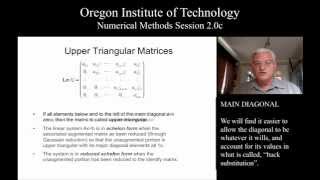
Photo Gallery

OIT Math 451 session 2.0c: Terminology & Notation
OIT Math 451 session 0.2: Algorithms as Solutions
OIT Math 451 session 2.0a: Example of  a System of Linear Equations
OIT Math 451 section 1.1 : Numeric Representation to Support Automation
OIT Math 451 session 2.1c: Back Substitution & Measuring Error
OIT Math 451 session 0.1c: Preliminaries : Counting & Induction
OIT Math 451 session 2.2d: Linked Lists and Measuring Algorithm "Cost"
OIT Math 451 session 5.0: The Rectangle Rule
OIT Math 451 section 0.0: Introduction and Logistics
OIT Math 451 1.2a: Expressing a Function as a Polynomial Part I
OIT Math 451 session 0.1b: Preliminaries - rational & irrational numbers
OIT Math 451 section 0.1a: The Origins of Computation
View Detailed Profile
OIT Math 451 session 2.0c: Terminology & Notation

OIT Math 451 session 2.0c: Terminology & Notation

The basic language of Linear Algebra.

OIT Math 451 session 0.2: Algorithms as Solutions

OIT Math 451 session 0.2: Algorithms as Solutions

Well welcome back to

OIT Math 451 session 2.0a: Example of  a System of Linear Equations

OIT Math 451 session 2.0a: Example of a System of Linear Equations

Introduction of linear systems of equations using a fictional electronics manufacturing example.

OIT Math 451 section 1.1 : Numeric Representation to Support Automation

OIT Math 451 section 1.1 : Numeric Representation to Support Automation

Numeric representations on moder computers.

OIT Math 451 session 2.1c: Back Substitution & Measuring Error

OIT Math 451 session 2.1c: Back Substitution & Measuring Error

Findin the solution of a triangular system using backward substitution.

OIT Math 451 session 0.1c: Preliminaries : Counting & Induction

OIT Math 451 session 0.1c: Preliminaries : Counting & Induction

Induction as a means to prove proposed formulas and some useful formulas that count the number of computations before they ...

OIT Math 451 session 2.2d: Linked Lists and Measuring Algorithm "Cost"

OIT Math 451 session 2.2d: Linked Lists and Measuring Algorithm "Cost"

Reducing the computations needed through the use of linked lists. We will also learn to calculate the cost of algorithms by ...

OIT Math 451 session 5.0: The Rectangle Rule

OIT Math 451 session 5.0: The Rectangle Rule

Applying the classic

OIT Math 451 section 0.0: Introduction and Logistics

OIT Math 451 section 0.0: Introduction and Logistics

THIS INTRODUCTION MODULE IS OUT OF DATE This is the course overview for

OIT Math 451 1.2a: Expressing a Function as a Polynomial Part I

OIT Math 451 1.2a: Expressing a Function as a Polynomial Part I

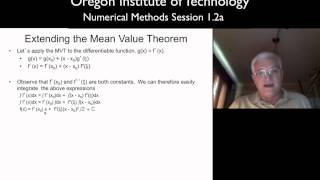
Introducing the Taylor Series as a consequence of the Mean Value Theorem.

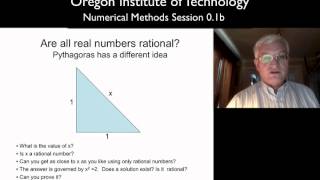
OIT Math 451 session 0.1b: Preliminaries - rational & irrational numbers

OIT Math 451 session 0.1b: Preliminaries - rational & irrational numbers

Understanding the nature of our modern

OIT Math 451 section 0.1a: The Origins of Computation

OIT Math 451 section 0.1a: The Origins of Computation

Introduction to Numeric Systems and Computation.

OIT Math 451 session 1.2b: Expressing a Function as a Polynomial Part II

OIT Math 451 session 1.2b: Expressing a Function as a Polynomial Part II

Expressing a Function as a Polynomial Part

OIT Math 451 session 3.3: The Secant Method

OIT Math 451 session 3.3: The Secant Method

Adapting the Newton-Raphson to case where the function being evaluated is available only in table form.

OIT Math 451 section 4.3a: Numerical Differentiation I

OIT Math 451 section 4.3a: Numerical Differentiation I

OIT Math 451 section 4.3a: Numerical Differentiation I

OIT Math 451 session 2.1b: Triangularization completed

OIT Math 451 session 2.1b: Triangularization completed

Completion of the triangularization algorithm.

OIT Math 451 session 2.1a: Triangularization through column 1

OIT Math 451 session 2.1a: Triangularization through column 1

Creating P-code needed to triangularize a matrix. This is a two part series, taking you through the 1st column only.

OIT Math 451 session 4.1b-1: Newton Interpolation   1 of  2

OIT Math 451 session 4.1b-1: Newton Interpolation 1 of 2

Newton's approach to polynomial interpolation.

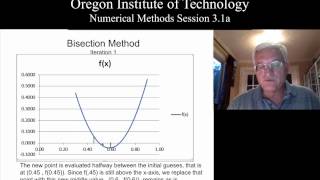
OIT Math 451 session 3.1a: The Bisection Method : Concept & Algorithm

OIT Math 451 session 3.1a: The Bisection Method : Concept & Algorithm

In our last

OIT Math 451 section 0 0   summer 2017

OIT Math 451 section 0 0 summer 2017

OIT 451