Media Summary: As still as the night sky may seem, it is in fact bustling with activity and change, and nowhere is this more obvious than in the ... This is the work-flow till now to build an astro micro- We've only been finding exoplanets, planets that orbit around other stars, for less than three decades and already we've found ...

Observatory Online Transient Events - Detailed Analysis & Overview

As still as the night sky may seem, it is in fact bustling with activity and change, and nowhere is this more obvious than in the ... This is the work-flow till now to build an astro micro- We've only been finding exoplanets, planets that orbit around other stars, for less than three decades and already we've found ... Cassidy Mihalenko, a PHD student at Utas, will present a guided tour of the Talk by Alessio Berti (MPP) at the 3rd Astro-COLIBRI Multi-Messenger Astrophysics workshop (September 2024, Institut ... With relatively few telescopes operating in the near infrared (NIR), and even fewer available for Target of Opportunity observations ...

Discover the future of astronomy with the **Vera C. Rubin What goes “bump” out in space? Why do astronomers care about these fleeting 2023-05-04 - IoA Colloquium by Danny Steeghs Following on from the epoch of multi-wavelength astronomy, we have recently ... A seminar by Shri Kulkarni, in the frame of the weekly held Institut d'astrophysique de Paris' specialised seminars, on Friday, ... Stephanie Figuereo (UCSC), Raja GuhaThakurta (UCSC), Stefan Kimura (Willamette U), Rafael Nuñez (SFSU), Monika Soraisam ... GOTO is a fully robotic, wide-field, multi-site telescope array designed for rapid response to multi-messenger

Astronomers at Caltech have used a computer algorithm to classify 1000 supernovas, the bursting remnants of long-dead stars.

Photo Gallery

Observatory Online: Transient Events
Micro-observatory for detecting transient astro events
Observatory Online: Transiting Exoplanets
Observatories Forum 2025: Day1, Session1
Members Social Evening - Our Transient Universe
The Virtual Observatory & How to access it | Multimessenger Citizen Science for Amateur Astronomers
Transient sources with Cherenkov telescopes (Alessio Berti)
Joseph Durbak | Searching High Energy Transient Counterparts with the PRIME Telescope
Explore the Rubin Observatory's Cosmic Secrets!
"Transients from Space" Science Workshop
Multi-messenger astronomy: Chasing Gravitational Waves with the GT Optical Transient Observer (GOTO)
CHARTING THE TRANSIENT SKY: THE PALOMAR TRANSIENT FACTORY
View Detailed Profile
Observatory Online: Transient Events

Observatory Online: Transient Events

As still as the night sky may seem, it is in fact bustling with activity and change, and nowhere is this more obvious than in the ...

Micro-observatory for detecting transient astro events

Micro-observatory for detecting transient astro events

This is the work-flow till now to build an astro micro-

Observatory Online: Transiting Exoplanets

Observatory Online: Transiting Exoplanets

We've only been finding exoplanets, planets that orbit around other stars, for less than three decades and already we've found ...

Observatories Forum 2025: Day1, Session1

Observatories Forum 2025: Day1, Session1

Observatories

Members Social Evening - Our Transient Universe

Members Social Evening - Our Transient Universe

Cassidy Mihalenko, a PHD student at Utas, will present a guided tour of the

The Virtual Observatory & How to access it | Multimessenger Citizen Science for Amateur Astronomers

The Virtual Observatory & How to access it | Multimessenger Citizen Science for Amateur Astronomers

"The Virtual

Transient sources with Cherenkov telescopes (Alessio Berti)

Transient sources with Cherenkov telescopes (Alessio Berti)

Talk by Alessio Berti (MPP) at the 3rd Astro-COLIBRI Multi-Messenger Astrophysics workshop (September 2024, Institut ...

Joseph Durbak | Searching High Energy Transient Counterparts with the PRIME Telescope

Joseph Durbak | Searching High Energy Transient Counterparts with the PRIME Telescope

With relatively few telescopes operating in the near infrared (NIR), and even fewer available for Target of Opportunity observations ...

Explore the Rubin Observatory's Cosmic Secrets!

Explore the Rubin Observatory's Cosmic Secrets!

Discover the future of astronomy with the **Vera C. Rubin

"Transients from Space" Science Workshop

"Transients from Space" Science Workshop

What goes “bump” out in space? Why do astronomers care about these fleeting

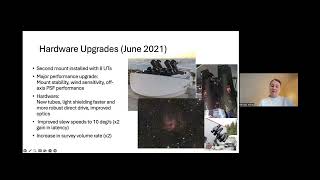
Multi-messenger astronomy: Chasing Gravitational Waves with the GT Optical Transient Observer (GOTO)

Multi-messenger astronomy: Chasing Gravitational Waves with the GT Optical Transient Observer (GOTO)

2023-05-04 - IoA Colloquium by Danny Steeghs Following on from the epoch of multi-wavelength astronomy, we have recently ...

CHARTING THE TRANSIENT SKY: THE PALOMAR TRANSIENT FACTORY

CHARTING THE TRANSIENT SKY: THE PALOMAR TRANSIENT FACTORY

A seminar by Shri Kulkarni, in the frame of the weekly held Institut d'astrophysique de Paris' specialised seminars, on Friday, ...

Prioritising Follow-up for Transient Surveys in the New Era of Time-Domain Astronomy

Prioritising Follow-up for Transient Surveys in the New Era of Time-Domain Astronomy

Prioritising Follow-up for

November 11, 2022: Variable Stars and Transients in the Andromeda Galaxy (M31)

November 11, 2022: Variable Stars and Transients in the Andromeda Galaxy (M31)

Stephanie Figuereo (UCSC), Raja GuhaThakurta (UCSC), Stefan Kimura (Willamette U), Rafael Nuñez (SFSU), Monika Soraisam ...

How to Filter Astrophysical Transients: Astro-COLIBRI Tutorial

How to Filter Astrophysical Transients: Astro-COLIBRI Tutorial

Master the art of

Rachel Street - Preparations for Microlensing with Rubin Observatory

Rachel Street - Preparations for Microlensing with Rubin Observatory

Microlensing

Kendall Ackley: The Gravitational-wave Optical Transient Observer (GOTO)

Kendall Ackley: The Gravitational-wave Optical Transient Observer (GOTO)

GOTO is a fully robotic, wide-field, multi-site telescope array designed for rapid response to multi-messenger

Astronomers at Caltech Have Used an Algorithm to Classify 1,000 Supernovae Completely Autonomously.

Astronomers at Caltech Have Used an Algorithm to Classify 1,000 Supernovae Completely Autonomously.

Astronomers at Caltech have used a computer algorithm to classify 1000 supernovas, the bursting remnants of long-dead stars.