Media Summary: Hi everyone today we're going to be talking about In the early days the UK had its own thoughts on how email addresses should look. Dr Julian Onions was there! Why do we have 8 bits in a byte? Professor Brailsford on the origins of the humble byte. Why Use Binary?

Endianness Explained With An Egg Computerphile - Detailed Analysis & Overview

Hi everyone today we're going to be talking about In the early days the UK had its own thoughts on how email addresses should look. Dr Julian Onions was there! Why do we have 8 bits in a byte? Professor Brailsford on the origins of the humble byte. Why Use Binary? We take multithreaded code for granted, but what's needed to make it work properly? We need two Dr Steve Bagleys to illustrate ... When a computer is dealing with a number greater than 255, it uses at least 2 bytes. Intel processors (and AMD) store these ... Surely decimal numbers are easier to understand than binary? So why don't computers use them? Professor Brailsford explains ...

Advanced Encryption Standard - Dr Mike Pound explains this ubiquitous encryption technique. n.b in the matrix multiplication ... Correction : as oodles of commenters have pointed out, the clock face should go from 0 to n-1. Also, worth reminding people that ... Back to basics, at the start of a series on binary numbers Professor Brailsford tackles binary addition and just what is meant by an ... Just what does it mean to have a multi-processor system? Dr Steve Bagley on symmetric and assymmetric multi-processor ... How do instant message apps do end to end encryption when one phone may not even be switched on yet? Dr Mike Pound on ... What's the absolute minimum you can compress data to? - Entropy conjures up visions of chemistry and physics, but how does it ...
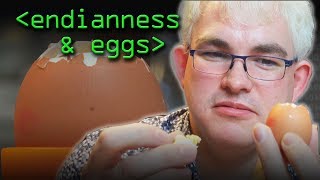
Photo Gallery

Endianness Explained With an Egg - Computerphile
Endianness Explained
Email Endianness Problems - Computerphile
Characters, Symbols and the Unicode Miracle - Computerphile
Where did Bytes Come From? - Computerphile
Multithreading Code - Computerphile
Lecture 22. Big Endian and Little Endian
Intel Chips Store Numbers Backwards - Little Endian vs Big Endian
Why Use Binary? - Computerphile
AES Explained (Advanced Encryption Standard) - Computerphile
Diffie Hellman -the Mathematics bit- Computerphile
Binary Addition & Overflow - Computerphile
View Detailed Profile
Endianness Explained With an Egg - Computerphile

Endianness Explained With an Egg - Computerphile

Byte ordering, or boiled

Endianness Explained

Endianness Explained

Hi everyone today we're going to be talking about

Email Endianness Problems - Computerphile

Email Endianness Problems - Computerphile

In the early days the UK had its own thoughts on how email addresses should look. Dr Julian Onions was there!

Characters, Symbols and the Unicode Miracle - Computerphile

Characters, Symbols and the Unicode Miracle - Computerphile

Audible free book: http://www.audible.com/

Where did Bytes Come From? - Computerphile

Where did Bytes Come From? - Computerphile

Why do we have 8 bits in a byte? Professor Brailsford on the origins of the humble byte. Why Use Binary?

Multithreading Code - Computerphile

Multithreading Code - Computerphile

We take multithreaded code for granted, but what's needed to make it work properly? We need two Dr Steve Bagleys to illustrate ...

Lecture 22. Big Endian and Little Endian

Lecture 22. Big Endian and Little Endian

Visit book website for more information: http://web.eece.maine.edu/~zhu/book.

Intel Chips Store Numbers Backwards - Little Endian vs Big Endian

Intel Chips Store Numbers Backwards - Little Endian vs Big Endian

When a computer is dealing with a number greater than 255, it uses at least 2 bytes. Intel processors (and AMD) store these ...

Why Use Binary? - Computerphile

Why Use Binary? - Computerphile

Surely decimal numbers are easier to understand than binary? So why don't computers use them? Professor Brailsford explains ...

AES Explained (Advanced Encryption Standard) - Computerphile

AES Explained (Advanced Encryption Standard) - Computerphile

Advanced Encryption Standard - Dr Mike Pound explains this ubiquitous encryption technique. n.b in the matrix multiplication ...

Diffie Hellman -the Mathematics bit- Computerphile

Diffie Hellman -the Mathematics bit- Computerphile

Correction : as oodles of commenters have pointed out, the clock face should go from 0 to n-1. Also, worth reminding people that ...

Binary Addition & Overflow - Computerphile

Binary Addition & Overflow - Computerphile

Back to basics, at the start of a series on binary numbers Professor Brailsford tackles binary addition and just what is meant by an ...

Multiple Processor Systems - Computerphile

Multiple Processor Systems - Computerphile

Just what does it mean to have a multi-processor system? Dr Steve Bagley on symmetric and assymmetric multi-processor ...

What is Endianness?

What is Endianness?

What is

How Signal Instant Messaging Protocol Works (& WhatsApp etc) - Computerphile

How Signal Instant Messaging Protocol Works (& WhatsApp etc) - Computerphile

How do instant message apps do end to end encryption when one phone may not even be switched on yet? Dr Mike Pound on ...

Entropy in Compression - Computerphile

Entropy in Compression - Computerphile

What's the absolute minimum you can compress data to? - Entropy conjures up visions of chemistry and physics, but how does it ...